Cherbourg: Learning to Make With People
Some of the most important lessons I have carried into Woodcraft Adventures Tasmania and toward FNB Hobart Makers were not learned in a workshop, a training room, or a business plan. They were learned in Cherbourg — sitting alongside people, watching, listening, and being willing to not know.
Arriving Without a Program
In 2022, as part of my social work studies, I had the chance to visit Cherbourg — a small Aboriginal community in Queensland’s South Burnett region, about 260 kilometres north-west of Brisbane. Cherbourg has a profound and painful history as a government reserve, a place where Aboriginal people from dozens of language groups were forcibly relocated from across Queensland throughout the twentieth century. It is also a community with deep resilience, a rich culture of making and maintaining things, and extraordinary people doing extraordinary work.
I arrived with what I hope was an honest position: I did not know. I was not there to deliver a program, to offer expertise, or to fix anything. I was there to learn — from the community, from its history, and from the people generous enough to share their time with a student who had a lot more to receive than to give.
That stance — arriving open rather than arriving equipped — turned out to be one of the most important things I could have brought.
The Men’s Shed and Meeting Wayne
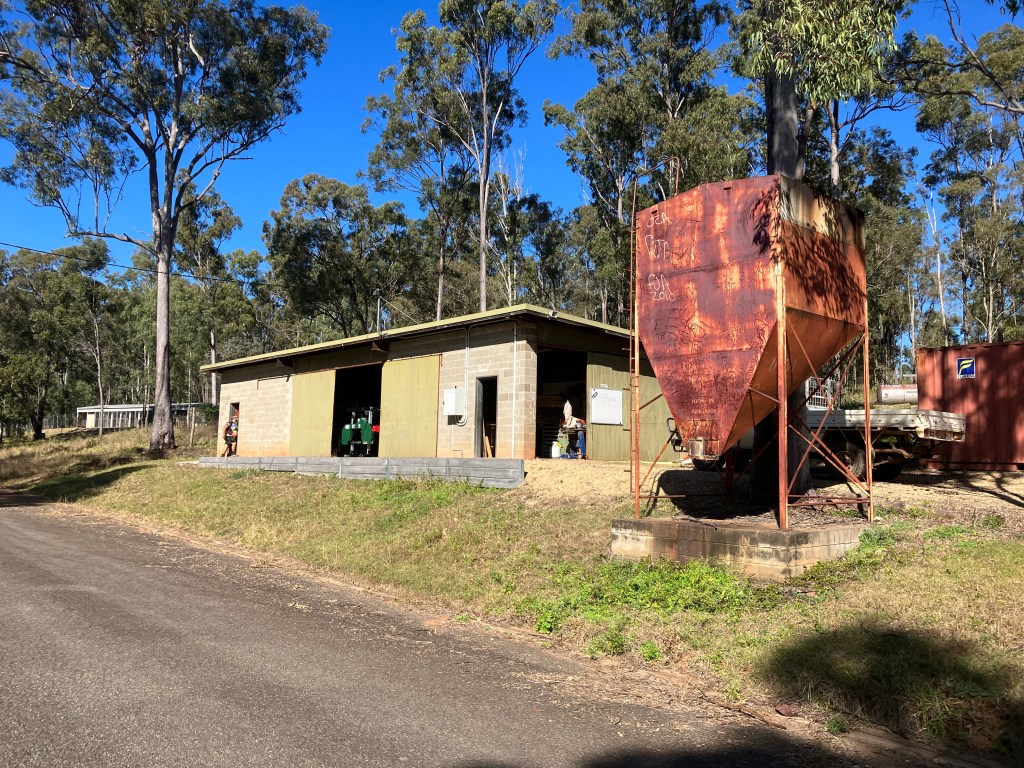
One of the places I spent time was the Cherbourg Men’s Shed. Men’s Sheds have taken root in communities across Australia as places where people — particularly men who might otherwise be isolated — can gather, make things, and belong somewhere. In Cherbourg, the Shed carried that spirit with its own distinct character: a place shaped by the people who used it, not imposed from outside.
I met Wayne there. I am careful not to speak for Wayne or to summarise him in a paragraph — that would not do justice to who he is — but I can say that he taught me more about community, patience, and making than most formal education had. Wayne moved through the shed with ease and ownership. He knew where things were, what they were for, how they worked. He was generous with that knowledge, but on his own terms, at his own pace. There was no transaction implied. Just the quiet willingness of someone who genuinely enjoys their craft and, occasionally, sharing it.
Working alongside him, I made a cutting board — a modest project by any measure, but one that required me to slow down, to follow rather than lead, to measure twice and trust the process. I also had the chance to make a bullroarer, one of the oldest sound-making instruments known — a thin piece of timber on a cord that, when swung overhead, produces a deep resonant hum that seems to come from the air itself. Holding one and feeling that sound travel up through your arm into your chest is an experience that stays with you.
The shed was not a service. It was a place. The difference matters enormously.
A reflection from the visit, 2022
The Ration Shed Museum and the History of Making
Part of the visit included time at the Ration Shed Museum — a preserved and curated space on the site where, under government administration of the reserve era, Aboriginal people were required to collect rations in exchange for their labour. The museum documents that history honestly and unflinchingly. It is a record of control: of people’s movement, their wages, their food, their relationships, and their working lives.
What struck me was the evidence of making throughout that history — the labour that built the town’s infrastructure, the craftsmanship in its buildings, the agricultural and pastoral work, the domestic production. Aboriginal people in Cherbourg made an enormous amount. They were skilled, industrious, and capable. But the fruits of that making were routinely extracted, controlled, or denied to them. Their productivity was captured by a system that did not recognise their full humanity.
I sat with that for a long time. And I kept thinking about the language we use in social services and community development: outputs, throughputs, units of service, measurable impact. The Ration Shed was, in its own brutal way, a system obsessed with outputs. It measured what people produced without ever really seeing who they were.
What I Was Actually Learning
The lessons from Cherbourg did not announce themselves as lessons at the time. They accumulated slowly, the way good things often do. But looking back, I can trace several clear threads.
Relationships Before Productivity
The shed worked because people wanted to be there. Not because they were enrolled in a program, not because attendance was tracked, not because there was a measurable outcome tied to their participation. The relationships in the room were the point — and the making happened naturally within that relational container. You cannot manufacture that dynamic by designing a program around it. You build it by showing up consistently, by being genuinely interested in people, and by letting them lead.
Listening Before Imposing
There is a particular temptation in social work and community development — and I felt it myself — to arrive with answers. To have read the literature, to know the evidence base, to have a model. Cherbourg complicated that. The community had its own knowledge, its own systems, its own ways of supporting people. My job was to understand those, not to overlay my framework on top of them. Listening is not a preliminary stage before the real work begins. It is the work.
Ownership and Place
The shed belonged to the people who used it. That sense of ownership — not legal title, but lived, cultural, relational ownership — made it a place people wanted to protect and maintain. When outsiders design spaces and programs for communities without that community’s genuine involvement and control, the result is something that never quite belongs. People use it, but they do not own it. They do not sustain it. They do not grieve it when it closes. Place and ownership are not incidental to community wellbeing. They are central.
The Limits of Treating People as Outputs
The Ration Shed gave me a visceral, historical frame for something I had observed abstractly in policy and funding discussions. When a system’s primary interest is in what people produce — how many sessions delivered, how many participants enrolled, how many skills acquired — it loses sight of the person making and doing the work. The history of Cherbourg is, among other things, a history of that dehumanisation at its most extreme. But the echoes of it appear in gentler form all through contemporary social services. I came away with a deep commitment to resisting the reduction of people to their outputs.
From Cherbourg to Tasmania: A Natural Progression
These lessons did not stay in Cherbourg. They came home with me and began to shape how I thought about making, support, and community in every context that followed.
Rustix was an early iteration — exploring how woodworking and creative making could become a livelihood pathway for people who often found themselves excluded from conventional employment. The emphasis there was on craft quality and the dignity that comes from producing something genuinely well-made.
Cognitive Factory deepened that thinking around neurodivergent makers — people whose cognitive styles, rhythms, and ways of engaging with material are often treated as deficits by workplaces rather than as assets. The question there was not how to fix people so they could fit existing structures, but how to build structures that fit people.
Woodwork Warriors pushed that further into peer support territory — the idea that working alongside someone in a shared creative project is itself a form of support, that the bench is a site of connection and meaning, not just productivity.
Microenterprise Builder tried to formalise some of what I had been learning about maker-led livelihoods: that the most sustainable small creative businesses are built on the maker’s own vision and skills, not on an external consultant’s plan. Support should enable, not direct. The framework exists to serve the maker, not the other way around.
Woodcraft Adventures Tasmania brought those threads together in Christiaan and Priscilla’s hands — handcrafted wooden animals, meaningful timber art, custom orders, and community workshops rooted in a particular place, a particular pair of people, a particular aesthetic sensibility. It is maker-led from the ground up. The business exists because the makers exist, not the reverse.
FNB Hobart Makers: Community as the Frame
FNB Hobart Makers is where this journey has been pointing all along. It is not a program. It is not a service. It is a community — a gathering of people who make things, who share skills, who believe that creativity is not a luxury for a talented few but a fundamental human capacity that deserves to be supported, celebrated, and given room to generate real livelihoods.
The name draws on the Food Not Bombs tradition — mutual aid, community ownership, the refusal to treat people as passive recipients of charity. Makers Not Barriers might be another way to say it. The idea is that the barriers to creative livelihood — access to tools, space, materials, networks, markets — are not personal failings. They are structural problems. And structural problems call for collective solutions.
In FNB Hobart Makers, the maker leads the project. Always. Support — whether that comes in the form of tools, workspace, skills exchange, connections to markets, or help navigating the bureaucratic requirements of running a small enterprise — is there to create conditions, not to control outcomes. The person with the idea, the hands, the vision, and the relationship to their craft is the one who decides what gets made, how it gets made, and what it means.
This is not naive idealism. It is a principled response to what I observed in Cherbourg, in social services, in the making world, and in my own experience. When support tries to lead rather than enable, it frequently makes things worse — not because the intentions are bad, but because the dynamic itself undermines the autonomy and dignity of the person being supported.
A shed that belongs to the people in it. Tools that serve the maker. Skills shared freely between neighbours. That is the model. It always was.
Shared Skills, Dignity, and Mutual Aid
FNB Hobart Makers is built on three interlocking ideas. The first is shared skills — the recognition that knowledge about making is not proprietary, that teaching someone to use a saw or a lathe or a router is an act of generosity that compounds over time, and that communities of practice are stronger than collections of isolated individuals.
The second is dignity — the conviction that every person who makes something well deserves to be seen and recognised for that, regardless of their background, their diagnosis, their employment history, or the market value of what they produce. Dignity is not a reward for productivity. It is a starting condition.
The third is mutual aid — the practice of giving and receiving support within a community without hierarchy or transaction as the primary frame. In mutual aid, the person who teaches a skill today may be the one who needs a hand with their market stall next week. The flows of support move in multiple directions. Everyone is both contributor and recipient.
Together, these ideas create the conditions for maker-led creative livelihoods — small, sustainable, meaningful ways of generating income through craft that do not require people to abandon what they make or who they are in order to fit a market template.
A Closing Reflection
I want to be clear about what I am and am not claiming here. I am not claiming that Cherbourg taught me to build FNB Hobart Makers. I am not speaking for the Cherbourg community, for Wayne, or for anyone I met there. I am not suggesting that my brief visit as a social work student gave me special insight into a community whose history and complexity I have barely begun to understand.
What I am saying is that the experience changed how I pay attention. It slowed me down. It made me suspicious of my own expertise. It made me more interested in who is in the room than in what the room is supposed to produce. And it gave me a felt sense — not just an intellectual one — of what it looks like when a making space genuinely belongs to the people in it.
That feeling — of a shed that is truly someone’s place, where the tools are familiar, the pace is human, and the making is its own reward — is what I am trying to build toward in Hobart. Not perfectly. Not without mistakes. But with the same principle at the centre: the maker leads. Everything else is in service of that.
If you are a maker in Hobart — or you know one — and this resonates, I would love to hear from you. FNB Hobart Makers is being built with people, not for them. That distinction is everything.


Leave a comment