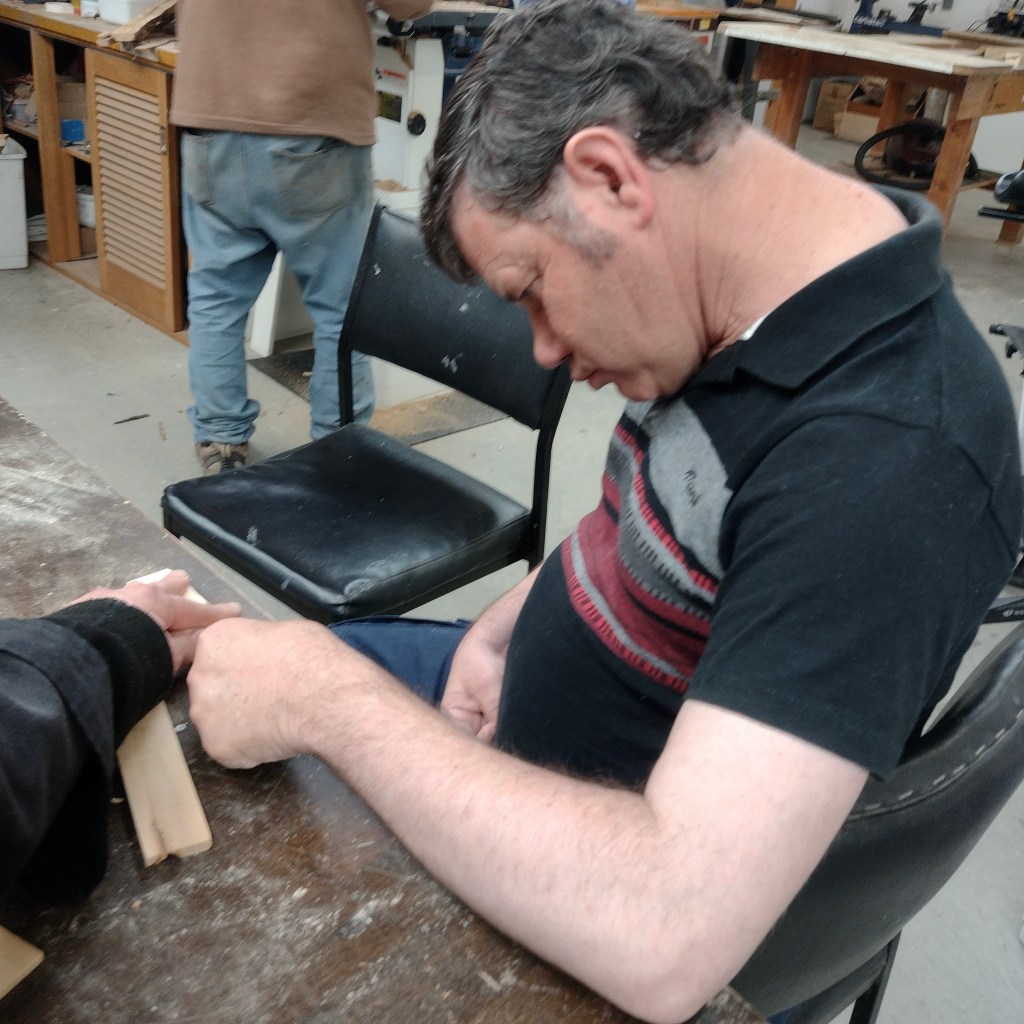
Cognitive Factory
This is an attempt to write honestly about something that mattered a great deal, that did not go as hoped in every respect, and that left behind lessons worth carrying forward. The Cognitive Factory was not a polished program. It was a working question — about whether woodworking could be structured in a way that genuinely included people with acquired brain injuries, not as therapy, not as charity, but as productive making with real social value. What it found along the way changed the direction of almost everything that followed.
Where It Came From
For a long time, woodworking for me was a solitary discipline. There was something clarifying about working alone with timber — the attention it demanded, the way it returned concentration. That satisfaction was real. But it was also, in retrospect, a little self-enclosed. The workshop was mine. The decisions were mine. The pace was mine.
The shift began through contact with people living with acquired brain injuries — people who had, often suddenly, lost access to capacities they had previously taken for granted. Cognitive changes after brain injury are not uniform. They include difficulties with sequencing, with memory, with sustained attention, with managing the pace of complex tasks. They can also include intact physical skill, strong motivation, and a deep need to do something that feels genuinely useful. What I began to notice was that the mismatch between those retained strengths and the way most productive work is structured was itself the problem — not the person.
The question that became the Cognitive Factory was simple to state and difficult to answer: could woodworking be designed — its sequences broken down, its processes made visible, its pace made adjustable — in ways that allowed people with acquired brain injuries to make real things, with real skill, without constant correction or supervision? Not simulated work. Not occupational therapy with a timber flavour. Actual making, with actual outcomes.
Designing for Cognitive Access
The first and most important discovery was that the problem was not with the people — it was with how woodworking had been set up. Standard workshop practice assumes a great deal: that you can hold multiple steps in mind simultaneously, that you can interpret ambiguous instructions, that you can self-correct when something goes wrong, that you can tolerate the open-endedness of a half-finished object. For people with certain kinds of acquired brain injury, these assumptions created invisible walls.
What followed was a long process of redesigning — not dumbing down, but making explicit what skilled woodworkers carry implicitly. Tasks were broken into discrete, self-contained steps. Jigs were built not just for accuracy but for orientation: so that the correct position of a piece was physically obvious without needing to be remembered or inferred. Visual cues were embedded into workstations. Sequences were documented not as instructions to be read but as physical flows to be followed — the next step was always visible from where you stood doing the current one.
There were also adjustments that had nothing to do with cognitive load and everything to do with dignity. People were not positioned as learners being supervised. They were positioned as makers doing a job. The language in the workshop shifted accordingly. The role of whoever else was present — whether that was me or another participant — shifted from instructor to co-worker. These distinctions sound small. They were not small. They determined whether someone felt capable or corrected, contributing or accommodated.
What It Tried to Make Possible
The Cognitive Factory was trying to create conditions for several things at once, and it is worth naming them separately, because they sometimes pulled against each other.
It was trying to make real work accessible — not simulated or simplified into meaninglessness, but genuinely productive making that resulted in objects people wanted to buy or give. This mattered because the value of the work to the maker depended in part on whether the work had value in the world. A thing made carefully and sold honestly carries different weight than a thing made as an exercise and discarded.
It was trying to create genuine social participation — not the managed inclusion of vulnerable people in spaces controlled by professionals, but actual making communities where different cognitive styles and capacities coexisted without hierarchy. This was harder than the task design. Systems can be engineered. Social dynamics are more stubborn.
And it was trying to understand whether a making enterprise organised around accessibility rather than productivity could sustain itself — economically, socially, emotionally. This was the question the Cognitive Factory never fully answered, and the not-answering of it was itself important.
What Was Learned About Capacity
The clearest thing learned was that capacity is not fixed and not individual. It is relational and contextual. People who appeared, in clinical or assessment settings, to have significant functional limitations often showed very different capacities in a workshop environment where the task was clear, the role was real, and the people around them were working alongside rather than observing.
This is not a surprising finding in the abstract — it aligns with what disability scholars and self-advocates have argued for decades. But watching it happen concretely, in a workshop, with specific people and specific pieces of timber, gave it a different kind of weight. The capacity was always there. The environment had been wrong.
A second thing learned was about fatigue and pace. Cognitive fatigue after acquired brain injury is real and often invisible. Someone might appear to be managing well and then, suddenly, not — not because they lost interest or became less skilled, but because a threshold had been crossed that the external world gave no signal of approaching. One of the most important design changes in the Cognitive Factory was building rest and transition into the structure of the work itself — not as accommodation, but as part of the rhythm of the day, available to everyone.
A third thing learned was about error and correction. Woodworking involves mistakes. Material is miscut. Joints do not seat properly. Surfaces are marked. In conventional workshop settings, correction is part of the teaching relationship and is relatively emotionally neutral. In the Cognitive Factory, what became clear was that the social meaning of error — who noticed it, how it was addressed, whether it was treated as a problem with the work or a problem with the person — had enormous consequences for whether someone remained engaged and returned. Designing for mistake-tolerance was not just about the jigs. It was about the culture of the room.
The Limits of Productivity-Focused Models
The tension that the Cognitive Factory could not resolve — and did not try to paper over — was the tension between accessibility and productivity, understood in the economic sense. Accessible work takes longer. It requires more setup. It involves more flexibility in pace and output. These are not deficiencies; they are features of a model that prioritises genuine inclusion. But they sit uneasily with the economics of a making enterprise that needs to cover its costs.
The mainstream disability employment model — particularly the supported employment and Australian Disability Enterprise frameworks of the time — tended to resolve this tension by subsidising productivity: paying people less than award wages, treating the gap between a person’s output and the market rate as something to be filled by government funding rather than questioned as a design failure. The Cognitive Factory was deeply uncomfortable with this resolution. It felt like a way of making the economics work by externalising the cost onto the people doing the work — by treating their time as worth less.
But the alternative — valuing the work at full market rates, pricing accordingly, and finding buyers willing to pay — ran into its own limits. Handmade timber goods are not cheap to produce even in fully conventional workshops. The price point required to make an accessible workshop economically viable was one that significantly narrowed the market. And the grant funding available for social enterprise ventures came with its own conditions and timelines that did not always match the slow, relational pace of what was actually being built.
What the Cognitive Factory came to believe was that the question of economic sustainability needed to be separated from the question of value. The work had value — social, relational, educational, aesthetic — that did not show up in a revenue line. The challenge was not to make the model more productive. It was to find forms of organisation that could hold the full range of value the model was generating, rather than measuring it against a single metric it was never designed to maximise.
Relationships and the Work of the Room
What no systems design fully accounts for is the relational texture of a shared workshop. The Cognitive Factory was, at its best, a room where people were genuinely glad to be — not because it was easy or because it delivered clear outcomes, but because something was being made together and that mattered. There were conversations that would not have happened anywhere else. There were moments of competence and pride that were not manufactured by a program design but arose from the work itself.
There were also harder moments. People came with complex histories. Brain injury does not arrive in isolation — it arrives with grief, with changed relationships, with altered senses of self. The workshop was not a clinical space and did not try to be one. But it was not isolated from those realities either. What became clear over time was that the relational support around the making — the attention to who was in the room and how they were doing — was not separable from the making itself. You could not run a good workshop by attending only to the timber.
This was also, honestly, one of the reasons the Cognitive Factory could not scale easily. The relational attentiveness that made it work well was not a transferable procedure. It depended on the people in the room — on their willingness to be present to each other, not just to the task. That quality does not survive being converted into a training module.
Moving Toward Community Making
The move from the Cognitive Factory toward broader community making was not a clean transition. It was more like a gradual recognition that the questions the Cognitive Factory was working on — about accessible work, about dignity, about the social value of making, about the limits of productivity as an organising principle — were not specific to acquired brain injury. They were general questions about how making communities work, and who gets to be part of them.
Woodwork Warriors grew out of a recognition that the workshop skills and systems developed in the Cognitive Factory context were useful to a wider range of people who were, for various reasons, excluded from conventional making spaces — by confidence, by prior experience, by the cultures of those spaces, by economic access to tools and materials. The accessible design principles were not less relevant in this broader context; they were more obviously relevant. What had been designed for one kind of cognitive difference turned out to be useful for almost everyone.
Microenterprise Builder took a different angle on the same core problem: that the economic structures available to people who make things at small scale are often inadequate, extractive, or simply absent. If the Cognitive Factory had learned that productivity-focused models distort the value of accessible work, Microenterprise Builder was an attempt to think carefully about what other economic forms might be available — what it means to run a very small making enterprise in a way that is honest about its costs, clear about its value, and not dependent on treating the maker’s labour as the expendable variable.
FNB Hobart Makers — Food Not Bombs Hobart Makers — brought together the community-making instinct with a clearer political orientation. If the Cognitive Factory had been tentative about naming its critique of productivity models, FNB Hobart Makers was less so. Making things together, giving them away freely, refusing the logic of market valuation as the primary measure of worth: these were not just practical choices but commitments about how communities sustain themselves and each other.
What the Cognitive Factory Left Behind
The Cognitive Factory did not produce a replicable model. It did not generate a funding template or a franchise. It did not resolve the tension between accessibility and economic sustainability. What it left behind was a set of convictions, tested against practice, about what accessible making looks like when it is done honestly.
- Capacity is relational and contextual. What people can do depends enormously on how the environment is designed and how other people in it behave.
- Dignity is not separable from the structure of the work. The language, the roles, the way mistakes are handled — these are not peripheral to the model. They are the model.
- Productivity is not the right measure of the value of accessible work. Finding the right measure — or being honest about the fact that no single measure is adequate — is itself important.
- Accessible design improves things for everyone. The jigs, the sequencing, the embedded cues, the pace flexibility — none of these things harmed skilled woodworkers. They made the room better.
- Relational attentiveness is not a supplement to good making practice. It is part of it.
- Solitary woodworking is fine. But community making — messy, slow, relational, complicated — is capable of producing something that solitary making cannot.
These are not conclusions that required the Cognitive Factory to succeed by conventional measures. They are conclusions that came from taking its partial and complicated experience seriously — from paying attention to what was working even when the surrounding structure was not, and from being willing to sit with what did not work long enough to understand why.
A Note on Honesty
Writing about something like the Cognitive Factory honestly means resisting a few temptations. The temptation to make it sound more resolved than it was. The temptation to cast the people involved — participants, collaborators, funders, me — in roles that are cleaner than the actual ones. The temptation to write toward a lesson that justifies the difficulty.
The Cognitive Factory was a genuine attempt, made by people trying to do something worthwhile, that found some things and missed others and left some questions open. The people who came through it and made things in it were not there to be learned from, and writing about them — even without naming them — requires care. What I hope this account does is not to instrumentalise that experience but to keep it visible: the specific, material, relational work of trying to make making more just.
Woodcraft Adventures Tasmania grew from those questions. Not as an answer to them — they do not have a final answer — but as a place that keeps them alive in the work.


Leave a comment