Rustix: Ten Years of Making Alone
A reflection on a decade of recycled-timber furniture, Saturday mornings at Salamanca Market, learning to run a small business, and what solitude eventually taught me about community.
The Beginning: Timber and a Ute
Rustix started the way a lot of honest things start — without a plan, without a business name, and without much certainty about what would come next. There was timber: offcuts, old floorboards, demolished joinery, the kind of wood that gets skipped or burned. And there was the feeling — difficult to articulate at the time — that something worthwhile could still be drawn out of it.
In those early years, Rustix was a sole-trader operation in the plainest sense of the term. I was the designer, the sawyer, the sander, the bookkeeper, the delivery driver, and the customer-service department. The workshop was small, the margins were thin, and the learning curve was steep. But the work itself — the actual making — felt right in a way that was hard to argue with.
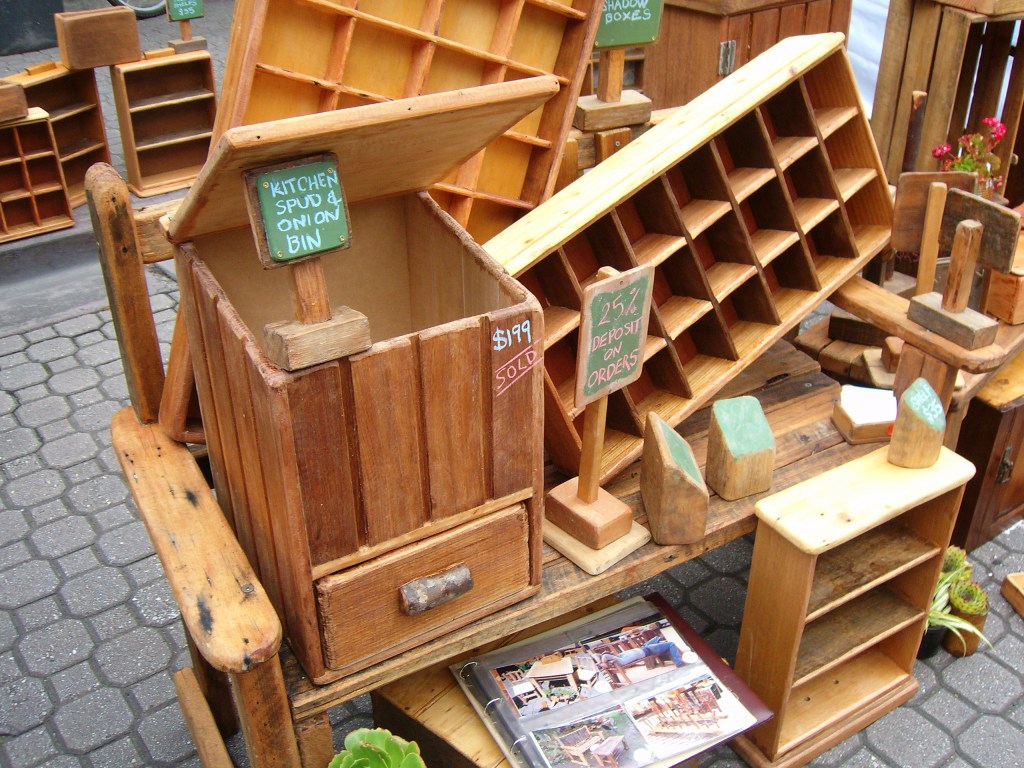
The furniture was never precious. It was recycled timber furniture: benches, shelves, tables, and stools shaped from wood that had already had a life somewhere else. The grain told stories — old nail holes, saw-blade burns, the weathering of decades. Part of the work was listening to what the timber wanted to be, rather than forcing it into shapes it wasn’t suited to.
Saturday Mornings at Salamanca
For a long time, Salamanca Market was the heartbeat of the business. Every Saturday morning, well before most of Hobart was awake, I was loading the ute — carefully, because the pieces were heavy and the ute had its limits — and driving down to the waterfront. Setting up a stall teaches you things that no business course can: how to display work so people stop walking; how to price fairly when you’ve poured forty hours into something; how to talk about what you make without overselling it or underselling yourself.
Salamanca is a generous place for makers. The market draws people who are genuinely curious, who want to know where something came from and who made it. Those conversations — standing behind a stall on a cool Hobart morning, watching someone pick up a stool and feel its weight — were often the best part of the week. They reminded me that making things is, in the end, a form of communication.
But it was also repetitive, physically demanding work. Pack up the workshop, load the ute, drive, unpack, sell, repack, drive home, unload. Do it again next week. There were Saturdays when the weather turned, or the sales were slow, or something got chipped in transit, and the whole enterprise felt fragile. Those days were instructive too.
Making things is, in the end, a form of communication. Salamanca reminded me of that every single week.
Learning the Business, Slowly
Sole trading in a creative field is a particular kind of education. You are simultaneously the artist and the accountant, the craftsperson and the brand. For the first few years, I was better at the former than the latter — most makers are. The workshop side of things had its own logic, its own rhythms. The business side felt like a foreign language I was only partially translating.
Microenterprise Builder came into the picture at a point when I needed to think more clearly about what Rustix actually was as a business. It’s one thing to make furniture; it’s another to understand your costs, your market position, your pricing structure, and whether the whole thing is sustainable. Those conversations — about planning, about resilience, about what a small business actually needs to survive — were sobering in the right way. They didn’t make me want to stop. They made me want to be smarter about how I continued.
Entrepreneurship, at the micro scale, is mostly about persistence in the face of ordinary difficulty. It’s not dramatic. It’s the slow accumulation of small decisions: which timber to source, which markets to attend, when to say yes to a custom order and when the job won’t pencil out. You learn by doing, and then you do it again with slightly less uncertainty.
The Limits and the Value of Working Alone
There is something genuinely good about solitude in the workshop. The concentration it enables, the uninterrupted attention to a piece of wood — these are not small things. Some of the best work I’ve done came out of long, quiet days where the only noise was machinery and the radio. Solitude has a kind of honesty to it. There’s no one else to blame when something goes wrong, and no one else to credit when it goes right.
But solitude also has its limits, and ten years showed me those limits clearly. Working mostly alone means there’s no one to catch the errors in your thinking, no one to suggest a different approach when you’re stuck in a rut, no one to share the load when things get heavy — literally or otherwise. The isolation that feels like freedom in year one starts to feel like something more complicated by year five or six.
I don’t think I could have named this clearly at the time. But looking back, I can see that what I was missing wasn’t company for its own sake — it was peers. Other people who understood what it meant to make things with their hands and try to make a living from it. People who could say: yes, I know that problem, here’s what I tried.
A Pathway Toward Community
The connection to FNB Hobart Makers didn’t happen overnight. It grew out of conversations, out of a gradual recognition that the questions I’d been wrestling with alone — about sustainability, about creative practice, about the economics of making — were questions that other people were wrestling with too. FNB Hobart Makers offered something that a decade of solo practice had made me genuinely hungry for: a community of makers thinking together about shared problems.
What Rustix gave me, unexpectedly, was the experience necessary to be useful to others. Ten years of making alone, of navigating the market, of learning the business, of sitting with failure and trying again — that turns out to be worth something in a community context. Not as expertise delivered from on high, but as hard-won familiarity with the particular difficulties of this kind of work.
There’s a kind of making that only happens between people: the making of shared understanding, shared infrastructure, shared possibility. I came to that understanding slowly, through the long corridor of solitude that Rustix provided. I’m grateful for the corridor. I’m more grateful for what’s on the other side of it.
Ten Years: What It Added Up To
A decade of Rustix produced a lot of furniture and a lot of learning. It produced recycled-timber pieces that are sitting in Hobart homes, doing their quiet work. It produced hundreds of Saturday mornings at Salamanca, thousands of small decisions, and a kind of resilience that I don’t think I could have built any other way.
It also produced a person who is, I think, better equipped to work with other makers now — not in spite of having worked alone for so long, but because of it. The things solitude teaches you about self-reliance and persistence are the same things a making community needs its members to carry. You can’t build something together unless the people building it know how to hold their own weight.
Rustix is still here. The timber is still recycled, the work is still handcrafted, and the ute still gets loaded on market days. But the frame around it has changed. What was once the whole story is now one thread in a larger weave — and that feels, after ten years, exactly right.


Leave a comment