Making as Authorship
When someone carves a small animal from a piece of Tasmanian timber, they are not just producing an object. They are making a decision — about shape, about grain, about what the wood wants to become. That decision belongs to them. We think this matters. Creativity is a form of authorship, and authorship is a form of dignity. The person who made a thing has a story that runs right through it, and no marketplace or middleman should be able to take that story away.
We believe that making with your hands — whether it is woodworking, carving, painting, weaving, or any other craft — builds something that goes well beyond the finished piece. It builds confidence. It builds a sense of competence and self-possession. And when it finds its way to someone who values it, it builds a modest but real form of economic participation. That participation does not need to be large to be meaningful. A fair return for skilled work, at a human scale, can change how someone thinks about what they are capable of.
Your Pace, Your Story, Your Independence
We are not here to manage anyone’s journey. We do not believe that people who have been excluded from conventional employment need to be fixed, assessed, or guided through a prescribed program before they are taken seriously. What we do believe is that people deserve access to practical skills, honest information, and real opportunities — and then the space to decide for themselves what to do with those things.
That means we try hard not to impose timelines, ambitions, or definitions of success that belong to us rather than to the people we work alongside. Some people come to a workshop looking for connection. Some are testing whether a skill might become income. Some simply want to make something with their hands for the first time. All of those are good reasons to be here, and none of them is more worthy than another. We keep people’s independence and their own account of themselves at the centre of everything we do.
Workshops as Shared Practice
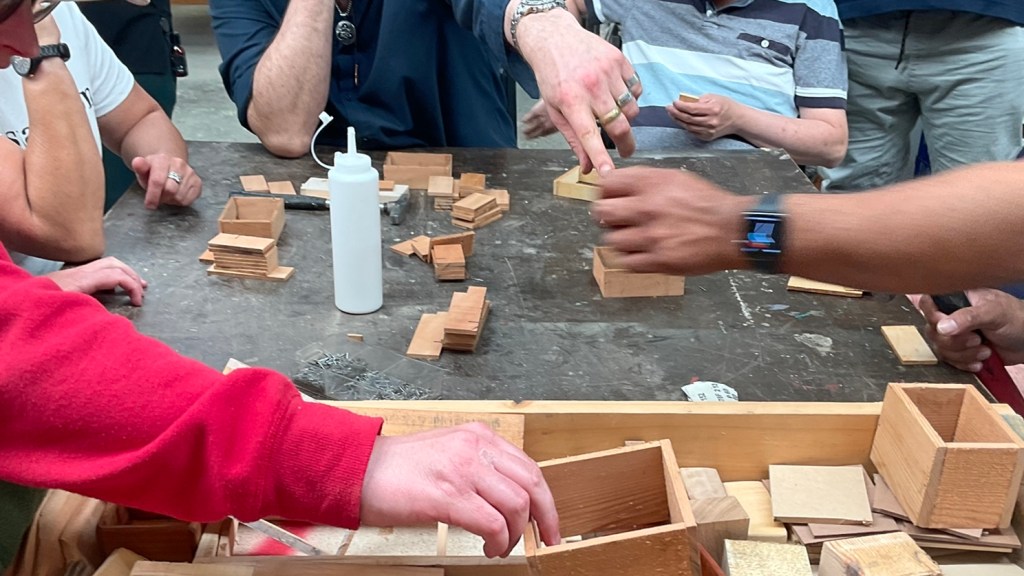
Our workshops are not classes in the traditional sense. We share skills the way practical knowledge has always been shared — by working alongside each other, asking questions, making mistakes, and trying again. We try to make every session genuinely accessible: to people who have never held a tool before, to people who are re-entering community life, and to people whose circumstances make conventional education feel distant or unwelcoming.
Inclusion, for us, is not a policy or a brochure word. It means that no prior experience is required, that we think carefully about cost and scheduling, and that we pay attention to the quiet signals that tell us whether a space actually feels safe to be in. A workshop that only works for people who were already comfortable is not doing what we want it to do.
Recognition and Fair Exchange for Local Makers
Local makers in Tasmania produce work of genuine quality and cultural value. Too often, that work goes unrecognised, underpriced, or absorbed into markets that benefit everyone except the person who made it. We think that is wrong, and we think it is changeable.
We want to create practical pathways — not just encouragement, but actual support — that help makers move from having a skill to having a sustainable practice. That includes help with pricing, with presenting work, with understanding where and how to sell, and with building the quiet infrastructure of a small creative business. We want makers to receive fair exchange for their work, to be visible in their community, and to feel that what they do has a place in the broader local economy.
The Spirit We Work In
We have been shaped by the tradition of Food Not Bombs — a movement built on the simple idea that sharing food, without conditions, is an act of solidarity rather than charity. The distinction matters. Charity can carry a quiet implication of hierarchy: someone gives, someone receives, and the two are not equal. Solidarity assumes that we are all in this together, that everyone has something to offer and something that is sometimes hard, and that meeting people without judgment is the only honest starting point.
That spirit runs through everything we do. We try to share resources — tools, knowledge, space, time — the way you would share a meal: freely, without a ledger, without requiring people to earn their place at the table. Community, as we understand it, is not a reward for good behaviour. It is the ground we all stand on together.
Mutual aid is not a program. It is a practice — the ongoing, ordinary act of looking out for each other because that is what communities do.
Why This Project Exists Now
Traditional employment has never worked equally well for everyone. There are people — because of health, history, neurodivergence, caring responsibilities, geographic isolation, or any number of other reasons — for whom the standard pathways feel closed or unsuited. We are not interested in debating whether that is fair. We are interested in building something different: grounded, accessible opportunities that meet people where they are.
We also believe that creative community is itself a form of local infrastructure, as real and as necessary as any other. When makers can sustain their practice, when skills are shared rather than hoarded, when people find connection through making together — the whole community is stronger for it. This project exists because we think those things are worth building deliberately, carefully, and with genuine respect for the people involved.
We are at the beginning of this work. We do not have all the answers. But we know what we believe, and we think that is a good place to start.


Leave a comment