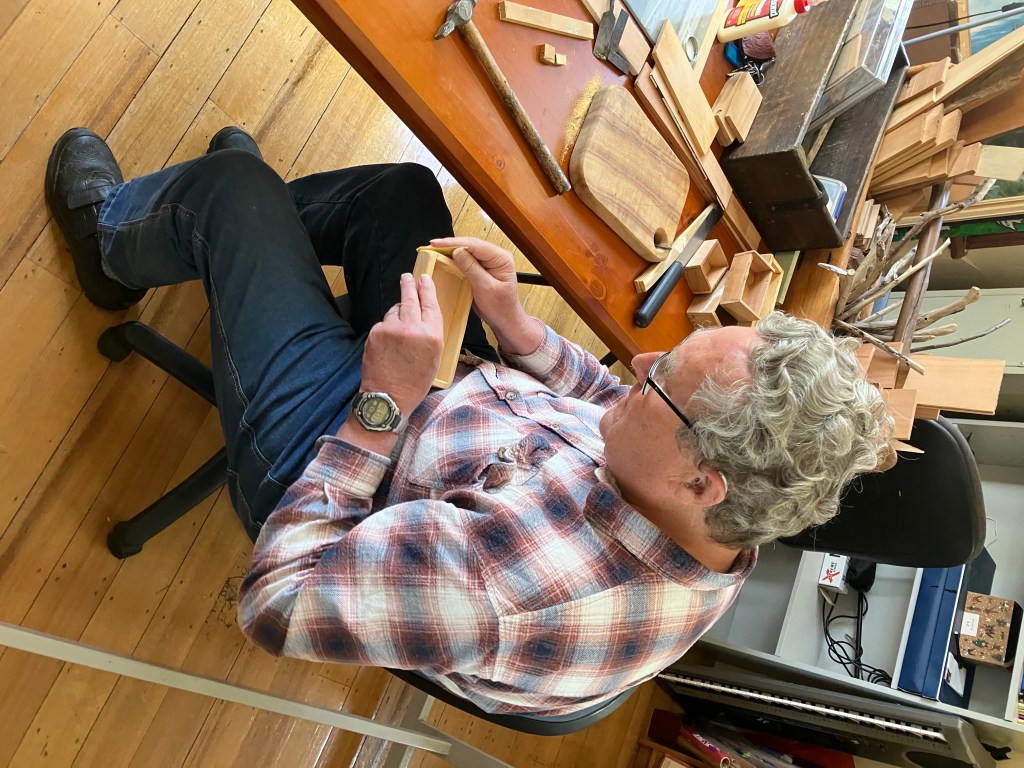
Woodwork Warriors: Making Space for Dignity
A reflection on psychosocial making, institutional life, and the long road from a workshop bench to a community of makers.
Where It Began
Woodwork Warriors began inside a psychosocial centre — one of those community spaces that exist in the complicated territory between mental health support and ordinary life. The name carried a deliberate edge. Warriors not because the people involved were fighting an illness, but because they were navigating systems that were often indifferent to what they could do, what they knew, and who they were. Coming to a workbench every week in that context takes something. It was worth naming.
The project grew from a belief — not a clinical hypothesis, but a practical conviction — that making things with your hands in the company of others is intrinsically worthwhile. That building a box, cutting a joint, finishing a surface, and handing someone something you made with care is a form of participation in the world. Not a stepping stone to something else. Not evidence of recovery. Just participation. The kind that carries dignity.
Early woodworking at the centre was deliberately unstructured in the therapeutic sense. There were no outcome measures attached to sawing a tenon correctly. There was skill, and attention, and the satisfaction of a thing fitting together. The space smelled of timber and linseed oil. That mattered. It signalled that this was a real workshop, not an activity room dressed up with tools.
Locked In, or Locked Out
People living with ongoing mental health challenges often find themselves in one of two impossible positions. The first is over-management: every hour accounted for, every decision brokered through a support worker or a care plan, every activity justified in terms of therapeutic goals. The second is exclusion: from work, from creative communities, from the informal networks through which most people build meaning and economic participation. You are either tracked and scheduled, or you are invisible.
Institutional settings — even well-intentioned ones — can replicate both traps simultaneously. The centre offers belonging, but sometimes at the cost of autonomy. It offers support, but sometimes in ways that inadvertently communicate that you cannot be trusted with an ordinary life. The woodshop was an attempt to push against that. Not to abandon support, which was genuinely needed, but to insist that support and dignity are not opposites, and that being treated as a maker rather than a patient changes something important in the room.
This tension is not easy to resolve, and Woodwork Warriors did not resolve it. What it did was hold it honestly. Some days the workshop ran smoothly and the conversation was about joinery. Other days someone arrived carrying something heavy, and the work slowed, or stopped, or changed shape. The measure of the project was not consistent attendance or productive output. It was whether people felt they belonged there — not as clients, but as makers.
The Tension Between Support and Control
Running a woodworking project inside a psychosocial service means navigating competing pressures constantly. Funders want to see activity, engagement, maybe employment pathways. Clinicians want to know that the environment is safe and that participants are not being set up to fail. The participants themselves want, more often than not, to be treated like adults who can decide when they are ready to pick up a chisel and when they are not.
There is a kind of institutional logic that creeps in when projects like this are formalised. Attendance sheets. Risk assessments. Documentation of participation that begins to feel like surveillance. These are not always wrong — some are legal requirements, others are genuine safety considerations — but they can subtly reframe what is happening in the room. A workshop where people are counted and categorised is a different space from one where people are simply present and making. Woodwork Warriors tried to keep the administrative apparatus as thin as possible, knowing that the thickness of it tends to be inversely proportional to the sense of freedom inside the space.
The resistance involved in this is real but quiet. It is not activism in any dramatic sense. It is the ongoing, low-key work of insisting that people are not reducible to their diagnoses, their attendance records, their outputs, or their compliance with a care plan. It is choosing, when you can, to let someone work at their own pace, to let them decide what they want to make, to let a session be unproductive by institutional measures and to call it a good day anyway.
What Cognitive Factory Taught Us — and Where It Stopped
The Cognitive Factory approach brought something genuinely useful to the woodshop: the idea that making processes can be designed to be accessible without being dumbed down. Breaking a complex joinery task into clear, repeatable steps — not to patronise, but to reduce the cognitive load of entry — meant that someone arriving at the bench after a rough week could still find a foothold. The system carried some of the burden, which left more room for the person.
But a system is not a relationship. Accessible processes matter, and Cognitive Factory’s influence on how the workshop was structured was real. Yet the woodshop also had to learn that psychosocial work moves at a different pace and requires a different quality of presence than a well-designed production system can provide. Trust is not built through clear instructions. It is built through showing up consistently, through not making a big deal of absence, through being genuinely interested in what someone is making and why, through allowing silence and uncertainty and the occasional session that amounts to nothing except two people sitting near a workbench talking about something entirely unrelated to wood.
The lesson is not that systems are bad — they are often what makes participation possible — but that in this context, the system has to serve the relationship, not the other way around. When the template is working but the person is not, you put the template down.
Pacing, Choice, and Room for Uncertainty
One of the most important things Woodwork Warriors learned is that choice — genuine, non-tokenistic choice — is not a luxury in psychosocial making. It is foundational. Whether someone works with hand tools or power tools. Whether they follow a structured project or explore freely. Whether they come this week or next. Whether they want company or quiet. These choices are not peripheral to the work. They are the work. They are how someone begins to trust a space and, through it, perhaps themselves.
Pacing is equally fundamental. The rhythms of mental health do not map neatly onto program schedules. Someone might be intensely engaged for three sessions and then absent for six weeks, returning as though nothing happened, ready to pick up exactly where they left off. A project that cannot hold that — that requires consistent attendance to maintain standing, or that treats gaps as failures — will lose the people who need the most room. Woodwork Warriors tried to be a space where you could always come back, without explanation or apology.
And uncertainty. Institutional settings rarely tolerate uncertainty well. But woodworking in a psychosocial context is full of it. You do not know what someone will be able to manage on a given day. You do not know if a project will be finished. You do not know if the thing being made will be kept, given away, or abandoned halfway through and never spoken of again. Holding that uncertainty without rushing to resolve it — without imposing a narrative of progress — is one of the harder skills the project had to develop.
How We Got Here: The Path Outward
What grew from Woodwork Warriors was not a clean success story. It was a gradual expansion of what was possible when you started from the principle that makers deserve real participation — not just therapeutic activity, but genuine creative and economic life. The move toward Microenterprise Builder was a recognition that some of the people who had come through the workshop wanted more than a supported space. They wanted to make things that were actually sold, that carried their names, that existed in the world in a way that was legible to people who had no idea what a psychosocial centre was.
Microenterprise Builder tried to hold that aspiration without letting it become another form of pressure. The goal was not to turn everyone into a small business operator. It was to create enough structure around the idea that people who wanted to try could do so without having to reinvent every wheel themselves. Shared tools, shared knowledge, shared pathways. The shift in language — from participant to maker to producer — was deliberate, and it mattered to people.
Woodcraft Adventures Tasmania emerged from that process as something more specific: a focus on Tasmanian timber, on the particular character of this island’s materials and landscapes, on handcraft as a way of being present to a place. The animals, the carved forms, the custom pieces — these are not products in the impersonal sense. They carry the marks of the hands that made them and the stories of the people and places that shaped those hands. That lineage runs back through the workshop bench at the psychosocial centre, even when it is not visible in the finished piece.
FNB Hobart Makers: Community Making as Mutual Aid
FNB Hobart Makers represents another turn in the same long thread. Food Not Bombs as a practice is built on the principle that people can feed each other, skill-share, and build community without waiting for an institution to sanction or organise it. The makers extension of that — bringing woodworking, repair, and fabrication skills into a mutual aid context — is a natural expression of what Woodwork Warriors was always reaching toward: a space where people make things together not because it is good for them individually, but because making together is itself a form of community.
The difference between a supported program and a mutual aid space is real, and it is not simply semantic. In a mutual aid context, there is no funder deciding what counts as a valid outcome, no clinician assessing appropriateness, no centre director weighing risk. People bring what they have — time, tools, skills, food, ideas — and offer it freely. The exchange is lateral rather than vertical. This does not make it easier, and it does not eliminate power dynamics, but it does change the texture of participation in ways that matter to people who have spent years being managed.
The connection to FNB Hobart Makers is not simply organisational. It is about the continuity of values: shared skills, maker-led projects, local creative livelihoods, and the commitment to building spaces where people belong on their own terms. That continuity is what makes the journey from Woodwork Warriors to here coherent — not as a programme that scaled up, but as a practice that kept finding new forms.
What Woodwork Warriors Still Teaches Us
Looking back, Woodwork Warriors was never primarily about woodworking. It was about resistance — not the dramatic kind, but the steady, unglamorous work of refusing to reduce people to their worst moments or their most visible struggles. It was about insisting, again and again in small ways, that the person across the bench is a maker, a thinker, someone with taste and skill and preferences, someone who deserves to spend an afternoon doing something real.
It teaches us that dignity is not something you provide. It is something you make room for. And making room is active work. It means designing spaces — physical, relational, institutional — that do not crowd it out. It means tolerating uncertainty and imperfection. It means being willing to have a session where nothing gets built and calling it worthwhile. It means understanding that belonging is not a reward for participation; it is the precondition for it.
The woodshop also teaches us something about scale. The impulse, when something works, is to replicate it, resource it, formalise it. Sometimes that is the right move. But the thing that works in a small, trusted, unhurried workshop is often precisely its smallness, its trust, and its refusal to hurry. The challenge in carrying any of this forward — into Microenterprise Builder, into Woodcraft Adventures Tasmania, into FNB Hobart Makers — is to keep that quality alive even as the form changes.
We do not always manage it. The pressures that drove people to the bench in the first place — economic, social, institutional — have not gone away. If anything they are sharper. But the practice persists. People show up, pick up tools, make things together, share what they know, and push back quietly against a world that would prefer them to be compliant, productive in the approved ways, or simply invisible. That is what the bench was always for.
Making together is not a therapy and it is not a programme. It is a way of being in community with each other — imperfect, unfinished, and worth the trouble.


Leave a comment